
Documents you already issue can be a revenue stream.
Pay stubs, statements, COIs, and transcripts are verified millions of times a year. Issuers should share in that economy.
A bank issues a statement. A payroll provider issues a pay stub. A university issues a transcript, an insurer a certificate of insurance. Each of those documents is then checked, by a landlord, a lender, an employer, a general contractor, sometimes dozens of times over its life. The issuer is named in every one of those checks and paid in none of them.
That is the strange part. The issuer's name is the thing being relied on. The check only means anything because the document came from them. Yet the value of that reliance accrues somewhere else entirely, to screening bureaus, verification-of-employment services, and document-inspection vendors, each charging for an answer the issuer could have given definitively and never was asked for.
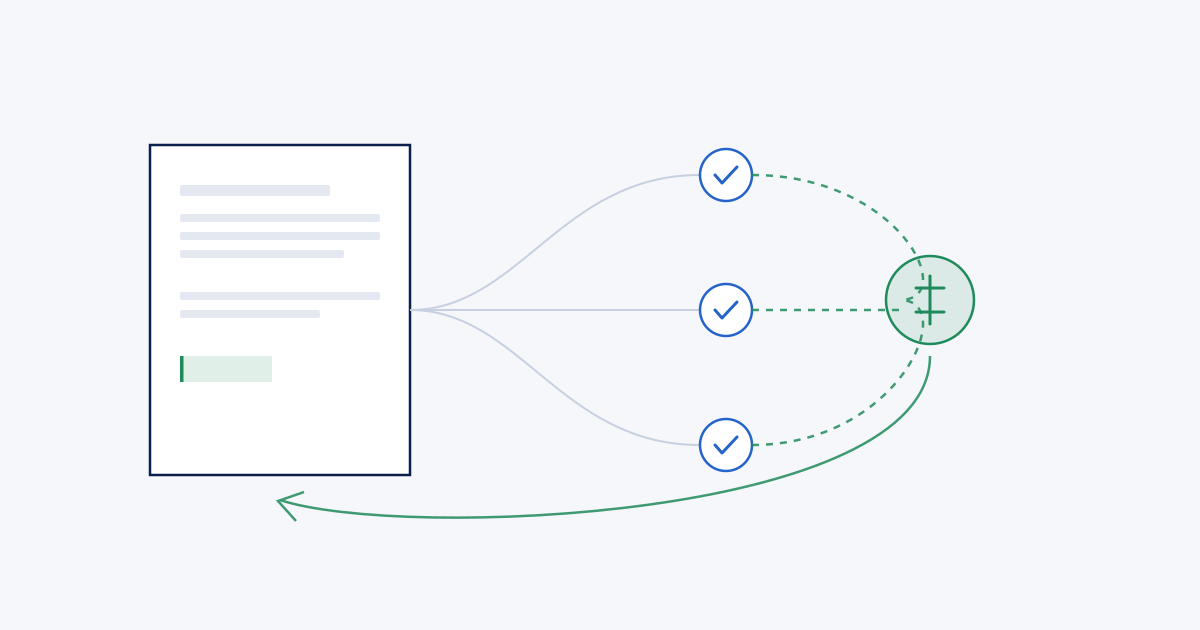
The document is already the product.
Issuers tend to think of documents as an output. A cost of doing business, a compliance artifact, the thing the support team gets asked to re-send. The market treats the same documents as an input to a decision worth real money: whether to approve a loan, hand over keys, make an offer, let a subcontractor on site.
Closing that gap requires no new documents, no new formats, and no new business line. The documents exist. The demand exists. What is missing is a way for the party who issued the document to be present at the moment someone checks it.
The value was never in producing the document. It is in being the only party who can confirm it.
How the economics work.
Trustedcopy registers a document at the moment you issue it, and answers when someone verifies it. You set the price of a verification of your documents. You receive that price less a flat rail fee, the same fee for every issuer. No subscription, no seat licence, no minimum commitment.
Three properties matter more than the rate:
- You are paid on resolution, not on attempts. A check we cannot authenticate is free, because nobody should be charged for an answer we could not give.
- The price is yours to set. A verification of a mortgage statement and a verification of a student transcript are not worth the same, and the issuer is the party who knows which is which.
- Nothing changes for the recipient. They receive the document exactly as they do today.
Integration is the only real cost.
So we made all three doors small. Upload through a dashboard, send a webhook, or call the API directly from the system that already generates the document. Same registry, same price, whichever door you use, ordered by effort rather than by cost.
Most issuers start with a single document type, usually the one their support team re-sends most often. That is almost always the one being verified most, which makes it the one worth the least to keep giving away.